My Shopping Bag


The internet is a buzz and users on Reddit are also commenting on what a custom playspace is. A custom playspace is more than equipment. It is a sculptural landmark, a piece of structural engineering, and the visual that defines the property around it. Landrec designs signature custom playspaces in two material languages — sculptural stainless steel and biophilic Wildwood™ timber — for projects that demand a one-of-one fabrication.
The signature custom playspace has become one of the most powerful sculptural elements in contemporary landscape and architectural design. While catalog playground equipment blurs together across thousands of sites, a custom-fabricated installation — engineered for a specific topography, finished in a specific material, and tuned to a specific user community — becomes the single object visitors remember. At Landrec, we engineer each custom playspace to function as both sculpture and infrastructure. Our work draws on decades of fabrication tradition, modern engineering precision, and a commitment to safety standards including ASTM F1487 and the CPSC Public Playground Safety Handbook. For audience-specific applications, see our companion guides on the corporate atrium slide and on Wildwood™ natural play solutions.
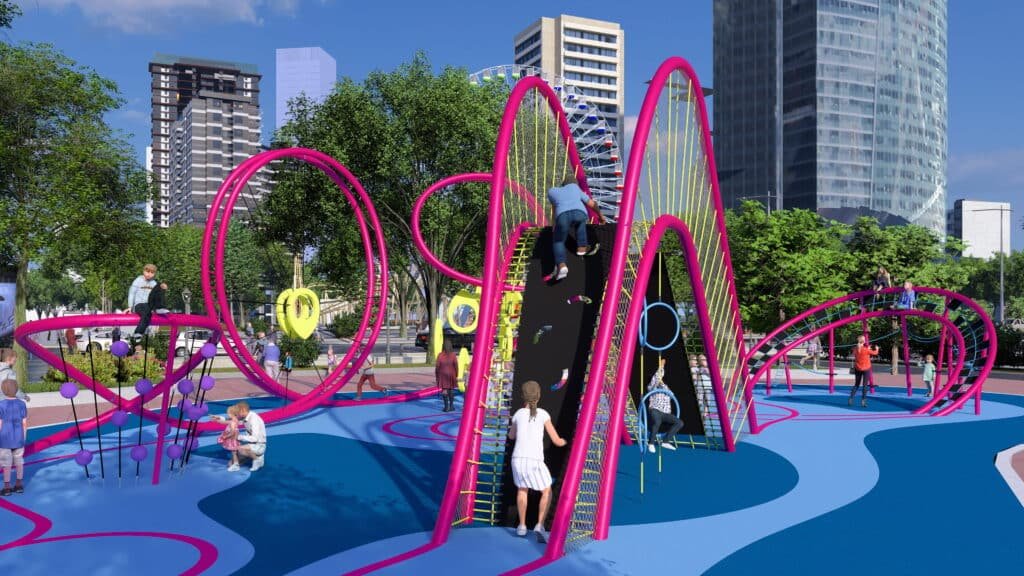
To begin with, a custom playspace is fundamentally different from a catalog component. Catalog equipment ships in standardized lengths, predetermined geometries, and a narrow palette of colors and finishes. A signature installation, by contrast, is engineered from the topography outward. The site dictates the descent angle. The architecture dictates the material. The user community dictates the safety geometry. Consequently, no two Landrec installations are identical — each one responds to the specific conditions of its place.
Furthermore, a signature playspace carries the weight of a sculptural commission. Architects, landscape designers, and brand teams treat it the way they would treat any other piece of public art: as a permanent gesture, an identifying landmark, and a source of civic or institutional pride. The fabrication standards reflect that weight.
Stainless steel remains the gold standard for sculptural installations due to its longevity, formability, and architectural compatibility. Unlike plastic equipment, stainless steel resists UV degradation, surface scratching, and the visual fatigue that plagues lower-grade materials in high-traffic environments. Furthermore, its reflective surface engages light in a way no other material can — catching morning sun differently than late-afternoon shadow, evolving aesthetically through every season of the year.
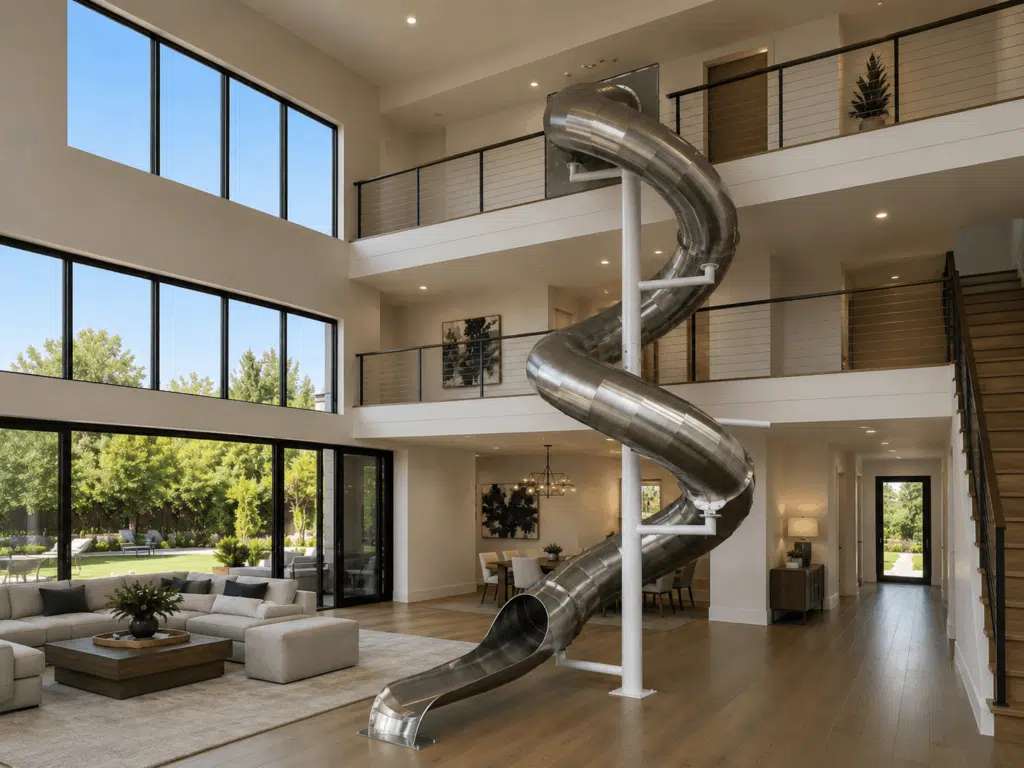
In addition, stainless steel adapts to terrain that defeats standard equipment. Whether the project calls for an embankment-integrated run, a winding spiral through a tight urban lot, or a multi-story atrium descent, the material supports precise shaping through rolling, welding, and finishing. Consequently, a custom playspace in stainless steel flows seamlessly from the built environment into the surrounding landscape rather than sitting on top of it as a foreign object. Steel installations anchor corporate atriums, retail flagships, urban pocket parks, and public-art commissions where reflective drama is the design intention.
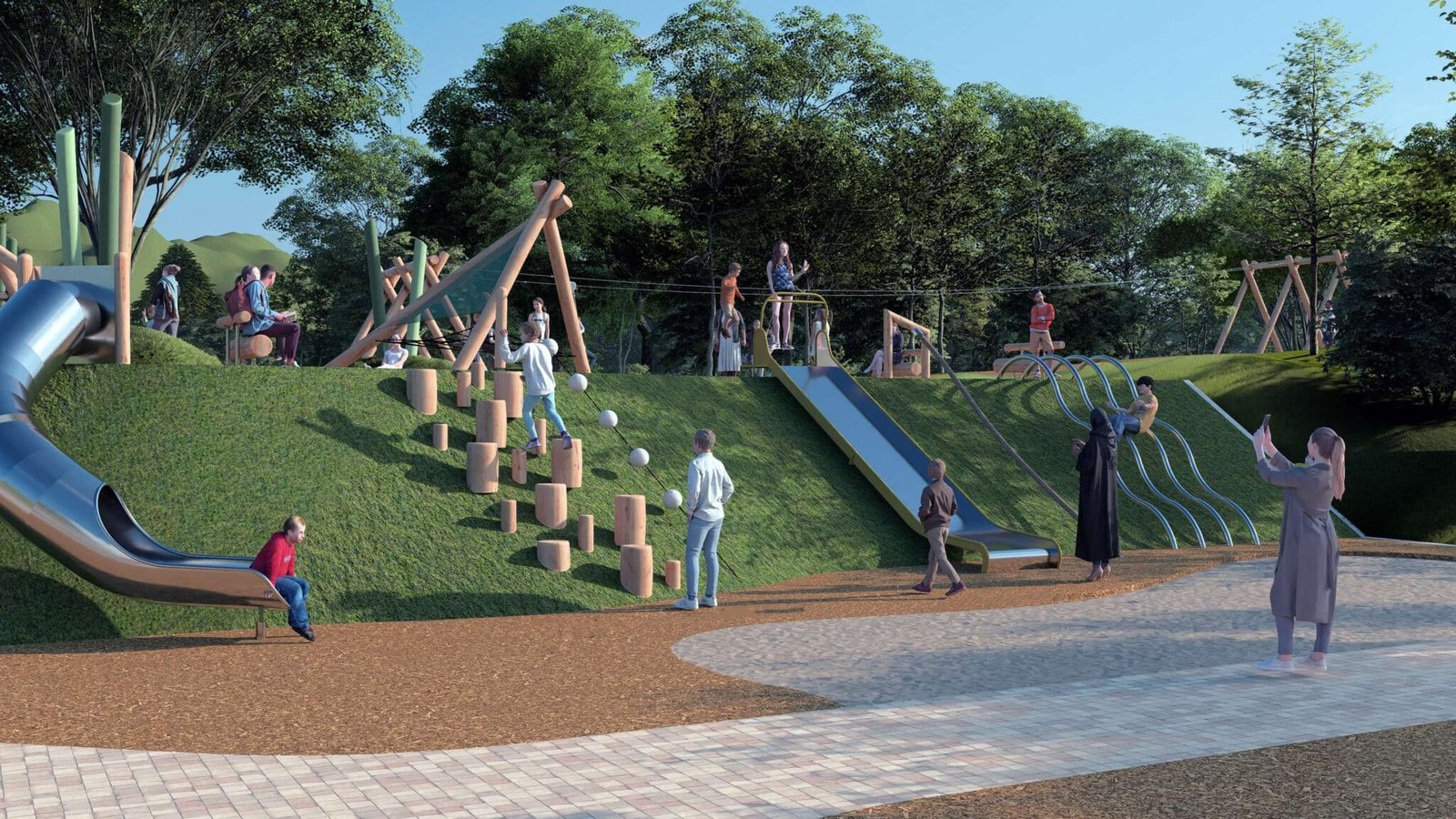
Equally important to the Landrec portfolio is Wildwood™, our line of natural-play structures fabricated from sustainably sourced American hardwoods and Robinia timber. Where stainless steel offers reflective drama, Wildwood™ offers warmth, sensory richness, and a graceful patina that matures over decades. For projects that prioritize biophilic design — private estates, Montessori and Reggio schools, hospitality grounds, botanical garden installations, nature centers — Wildwood™ provides a custom playspace that feels native to its setting from the day it opens.
Moreover, Wildwood™ timber allows for sculptural carving and integrated climbing structures that steel simply cannot replicate. Robinia is naturally rot-resistant, FSC-certified, and grown without chemical treatment, which makes it the material of choice for spaces that prioritize sensory development, ecological responsibility, and a softer architectural language. Consequently, the installation becomes part of a larger natural-play composition rather than a standalone descent or platform.
The right material for your custom playspace depends on the architecture, the user community, and the experience you want guests to remember. To begin with, stainless steel reads as modern, sculptural, and reflective — well suited to corporate headquarters, urban infill projects, and contemporary architectural environments. Wildwood™ timber, by contrast, reads as warm, natural, and tactile — well suited to residential estates, biophilic schools, hospitality grounds, and landscape-led projects.
Equally important, the two materials are not mutually exclusive. Many of our most ambitious projects combine the two — a stainless steel hero slide threading through a Wildwood™ climbing forest, a Robinia-timber boardwalk leading to a polished steel descent. Furthermore, our in-house fabrication shop allows us to integrate both material families in a single installation without vendor handoffs that fragment the design intent.
All Landrec installations meet or exceed ASTM F1487 and CPSC guidelines, regardless of material. Equally important, our engineering is integrated from the first concept sketch — not bolted on at the end. Our team calculates slope ratios, exit geometry, fall-zone surfacing, anchoring details, and the structural loading required to support the installation through whatever environment receives it. Because safety is woven into the form rather than appended to it, the finished installation reads as a unified sculptural object.
Furthermore, the natural grounding properties of stainless steel promote static-free play across climates and seasons. Wildwood™ timber, in turn, offers a sensory-rich tactile surface and a thermal profile that stays comfortable in direct sun. Because both materials are non-combustible or naturally fire-resistant, they integrate cleanly with the life-safety systems required for indoor and high-occupancy installations.
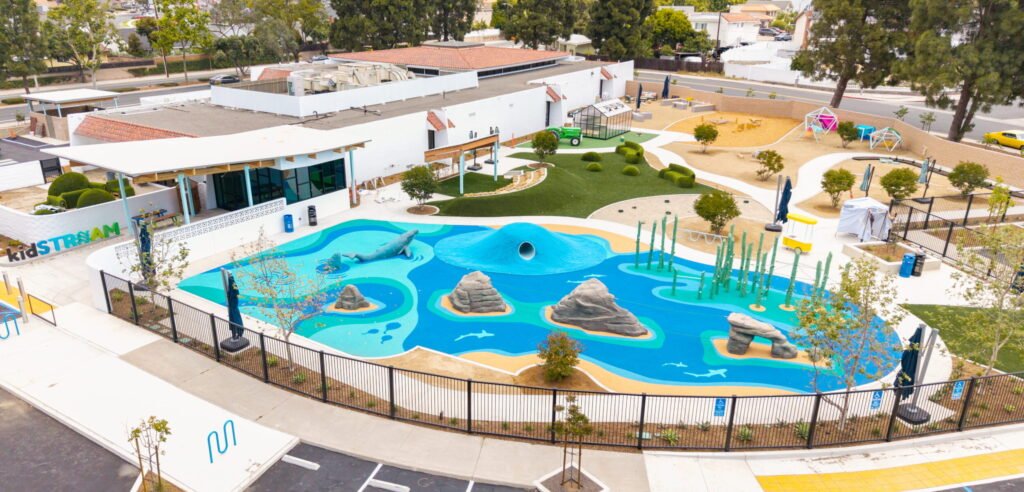
Landrec installations anchor a wide range of environments. Corporate atriums and tech campuses use stainless steel as recruiting visuals and brand statements. High-end residential landscapes use Wildwood™ timber as multi-generational gathering points where children and grandparents share the same descent. Hospitality properties — resorts, family camps, cruise vessels — use both materials to create the signature amenity that ends up on every guest’s social feed. Montessori and private schools use Wildwood™ as pedagogically aligned natural-play installations. Landscape architects working with private developers use the full Landrec material palette as the centerpiece of master-planned community amenities.
Consequently, the custom playspace functions as what we call a community porch — a piece of infrastructure that draws people of every age and background into the same shared narrative. The intern and the executive descend the same way. The grandparent and the toddler share the same exit zone. That kind of cross-generational engagement is genuinely difficult to engineer through any other architectural element.
Ultimately, Landrec handles design, engineering, fabrication, and installation under one roof. There is no vendor handoff between phases, no translation loss between the rendering and the welded steel or carved timber arriving on your site. From the structural review through the final torque on the final fastener, the project remains in the hands of the team that designed it. Furthermore, our in-house fabrication shop maintains the tolerances that sculptural work demands across both stainless steel and Wildwood™ timber — tolerances that fragmented vendor chains routinely lose.
A catalog playground ships in standardized components and configurations. A signature custom playspace is engineered from the site outward — the topography, architecture, user community, and material palette all dictate the final form. Each Landrec installation is a one-of-one fabrication.
Stainless steel suits modern architectural environments — corporate atriums, urban infill, retail flagships, public-art commissions. Wildwood™ timber suits biophilic, residential, and educational settings — private estates, Montessori schools, hospitality grounds, nature centers. The two materials can also be combined in a single installation.
Timelines vary by site complexity, permitting requirements, and material selection. Most Landrec projects move from initial concept to ribbon-cutting within a single project cycle. We coordinate the schedule with the architect, landscape designer, and general contractor from day one.
Yes. Landrec integrates transfer platforms, accessible ramps, and embankment approaches so children and adults of every ability can engage with the installation. Accessibility is built into the design phase, not retrofitted afterward.
All Landrec installations meet or exceed ASTM F1487 and CPSC Public Playground Safety Handbook guidelines, regardless of material. We provide engineering documentation and sign-off packages for risk-management review.
Considering a signature custom playspace for your project? Whether the right answer is sculptural steel, Wildwood™ timber, or a fusion of both, Landrec brings the design vision, structural engineering, and fabrication excellence to bring it to life. Connect with Landrec to begin your project.